Ramming mass is an unshaped refractory mixture compacted into position to form a heat-resistant lining. Instead of laying individual bricks, the installer packs graded particles around a former to create the vessel’s working shape. In a coreless induction furnace, the lining separates molten metal from the surrounding furnace assembly.
Silica ramming mass is also called acidic ramming mass because silica is an acidic refractory oxide. Here, “acidic” describes its refractory chemistry and compatibility with the process; it does not mean that liquid acid is added to the furnace.
01 · Inside the furnace
How ramming mass forms an induction furnace lining
The bottom is compacted first, followed by the sidewall material around the former. Particle grading and consistent compaction help create a dense lining with fewer voids. During the prescribed first heating cycle, the working face develops its bond through sintering. The installation and heating schedule must suit the selected grade and furnace.
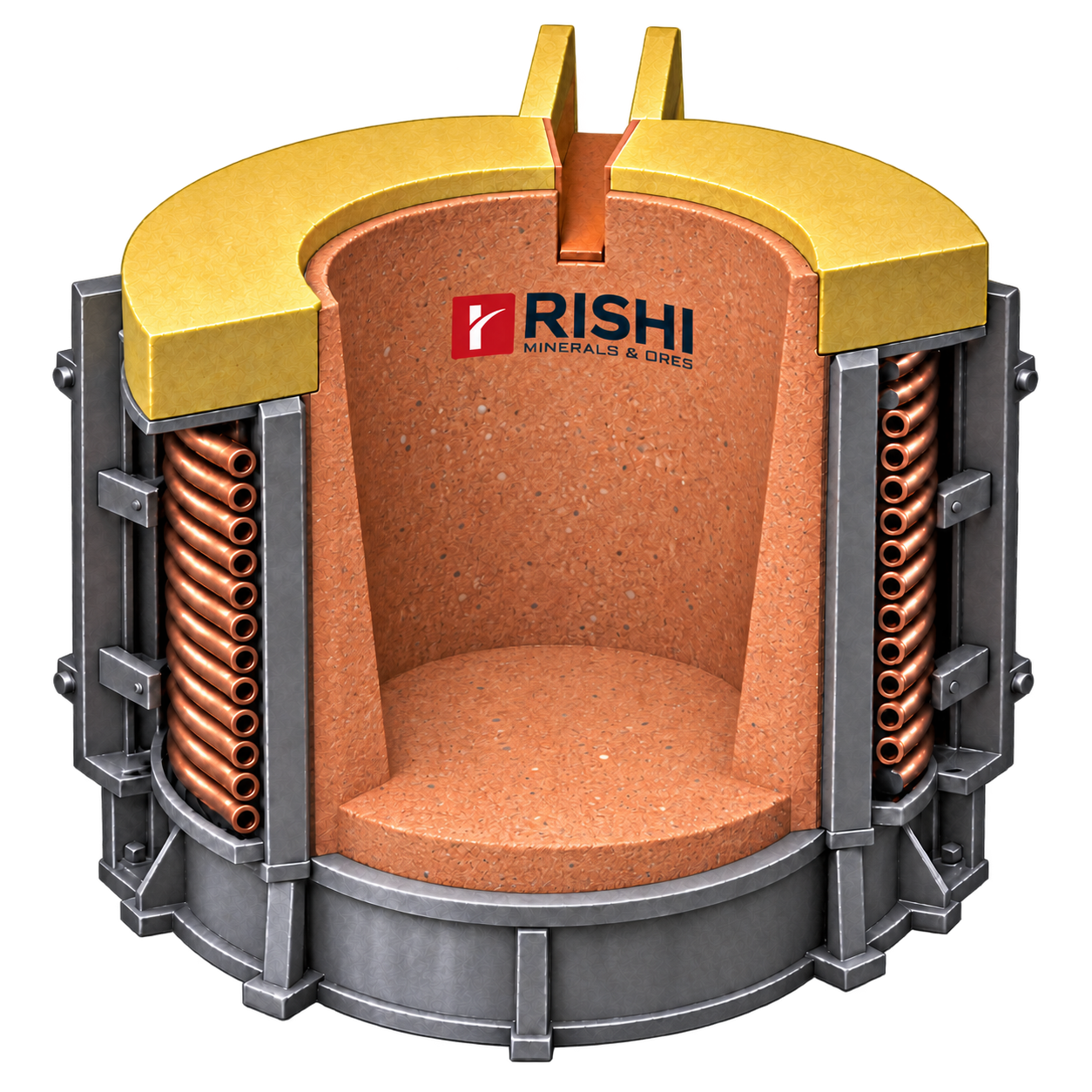
The working lining faces thermal cycling, movement of the molten bath and chemical interaction with metal and slag. A suitable refractory must be matched to all three. Furnace capacity alone does not determine the right material.
02 · Refractory chemistry
Types of ramming mass
1. Silica/Acidic Ramming Mass
Silica-based dry ramming mass uses a silica-rich mineral aggregate. Rishi Minerals uses selected quartzite, controlled particle sizes and a carefully blended binder for its premixes. These products serve suitable iron and steel melting applications in coreless induction furnaces and foundries.
It is important to match the mix to the charge, slag conditions and tapping temperature. Silica is not interchangeable with a basic or neutral refractory merely because all three can withstand heat.
View Rishi Silica/Acidic ramming mass grades ↗2. Basic Ramming Mass
Basic ramming masses are generally rich in magnesia. They are selected for processes requiring a basic refractory chemistry, including suitable steelmaking duties with basic slags. The specific formulation, metal chemistry and operating practice determine whether they are appropriate.
3. Alumina-Based Ramming Mass/ Neutral Ramming Mass
Neutral ramming masses commonly use alumina-based systems, including alumina-magnesia or spinel-forming formulations. They offer an alternative where the metal, slag and operating conditions call for a neutral lining. “Neutral” does not mean immune to every slag or suitable for every furnace.
More heats must be weighed against material cost
In Rishi Minerals’ indicative operating comparison, neutral ramming mass can achieve 2–3 times as many heats as silica ramming mass, but its material cost can be approximately 10 times that of Rishi Minerals’ Silica Ramming Mass.
These are company-provided comparative figures, not a universal performance or price guarantee. Actual results depend on the grades compared, furnace conditions, lining consumption and current quotations. Compare total lining cost per tonne melted, including relining downtime, rather than heats alone.
03 · Choosing the premix
Boron oxide and boric acid: two binder options
The binder is part of the grade selection. Its type and proportion influence the lining’s sintering behaviour; a higher percentage is not automatically better for every application.
Boron oxide premix
Boron oxide is an anhydrous binder, so it does not introduce chemically bonded water in the way boric acid does. Rishi supplies boron oxide premixes in different specifications, including 0.8% and 0.6% options. Dry storage and the specified installation procedure still matter.
Boron Oxide Premixes ↗Boric acid premix
Boric acid provides a cost-effective binder option but releases chemically bonded water during heating. The appropriate heating cycle and moisture-release provisions are therefore important. Rishi’s range includes 1.2% premix and dedicated foundry grades.
Boric Acid Premixes ↗Select the specification using your furnace capacity, tapping temperature and liquid-metal composition. Read the relevant product sheet and agree the application requirements with our team.
04 · Make a useful comparison
How to choose ramming mass for your furnace
A supplier recommendation is more useful when it starts with your actual operating conditions. Share the following information when comparing silica ramming mass grades or requesting a quotation.
| Operating detail | Why it matters |
|---|---|
| Furnace capacity and lining dimensions | Help establish the appropriate grade and material requirement. |
| Metal, charge mix and slag practice | Determine the chemical conditions the lining must withstand. |
| Tapping temperature and holding time | Describe the thermal duty more accurately than capacity alone. |
| Heats per day and shutdown pattern | Show the frequency of thermal cycling and operating interruptions. |
| Current lining life and wear pattern | Help distinguish grade selection issues from installation or operating issues. |
Compare cost per tonne melted
Track refractory purchased, material used per lining, repair consumption, heats achieved and tonnes melted during each campaign. Include installation labour and downtime when comparing alternatives. A longer campaign can be valuable, but it does not by itself prove a lower overall lining cost.
Share your furnace details and lining results ↗05 · Products by application
Ramming mass, spout mix and tundish refractories
Different parts of the melting and casting process have different duties. Use the product specified for each location instead of assuming that a furnace premix is suitable throughout the plant.
Explore boron oxide grades for the furnace working lining.
Boric acid premixesReview 1.2% premix and application-specific options.
SIL-RAM foundry gradesCompare dedicated foundry specifications and binder levels.
Nalitop spout and top mixA separate mix for the spout and top, used with the prescribed sodium silicate preparation.
T-CAST tundish refractory mixExplore Rishi’s tundish lining material and its application guide.
06 · Beyond the bag
What affects induction furnace lining life?
The refractory grade is only one part of the result. Rishi’s lining guidance also emphasises consistent compaction, an appropriate sintering cycle, charge quality and heat-by-heat records of temperature and wear.
- Keep material dry and protect it from contamination before installation.
- Follow the grade-specific compaction and former preparation requirements.
- Use the agreed first-heat schedule and moisture-release arrangements.
- Review tapping temperatures, holding periods and abnormal wear with the application team.
- Record campaign performance consistently so that changes in grade or practice can be compared.
Use our furnace lining protocol alongside the selected product specification and furnace manufacturer’s instructions. Application settings should be confirmed for the particular furnace.
07 · Common questions
Ramming mass questions answered
Is silica ramming mass the same as acidic ramming mass?
In this application, silica ramming mass is an acidic refractory. “Silica” identifies the main refractory constituent; “acidic” describes its chemical classification. The full grade specification is still needed to select a product.
Is ramming mass the same as refractory bricks?
No. Ramming mass arrives as an unshaped granular mixture and is compacted into a lining. Bricks are preformed shapes assembled into a lining. The appropriate system depends on the vessel and its operating requirements.
How many heats will a silica lining last?
There is no single reliable number for every furnace. Grade, metal and slag chemistry, tapping temperature, installation quality and operating pattern all affect campaign life. Share your current results and furnace details for an application-specific review.
Should neutral ramming mass always replace silica?
No. Neutral and silica linings serve different requirements. Consider chemical suitability, actual lining consumption, campaign life and total cost per tonne melted. A material with more heats is not automatically the most economical option for every operation.
Where can I find Rishi’s ramming mass specifications?
Visit our Silica/Acidic ramming mass product page for premix grades, foundry products and downloadable specification sheets. Our application team can help match a specification to your furnace.
Find the right lining for your operation.
Discuss your furnace capacity, metal chemistry and production requirements with Rishi Minerals, a Silica/Acidic ramming mass manufacturer in India.
Technical references
Rishi-specific product and application information draws on our original technical website, boron oxide guidance, boric acid guidance and lining practices. Use the current product specifications for grade-specific requirements.